 CROWN

The Bible encourages us to ask God for wisdom when life is confusing (James 1:5), listen to wise counsel rather than decide in isolation (Proverbs 15:22), and stay attentive to what we can faithfully do today (Matthew 6:34). It does not promise a private message telling us which job to take, whether to end a relationship or exactly what will happen next.
If you're confused, a useful place to begin is this: name the decision, read the relevant passage in context, identify what you still need to know and choose one responsible next step.
Maybe you're facing two opportunities and are frightened of choosing the wrong one. Maybe someone you trust has disappointed you and you're no longer sure what to believe. Or maybe you've prayed, opened your Bible and still feel uncertain.
Those experiences aren't interchangeable. Confusion about a new job is different from confusion after a breach of trust, and both are different from not understanding a passage of Scripture. A responsible biblical response starts by noticing that difference rather than giving everyone the same comforting sentence.
Why do I feel so confused?
Sometimes we lack information. Sometimes we have plenty of information but feel afraid of the consequences. Sometimes other people's expectations are so loud that we can barely hear our own questions. And sometimes we're wrestling with spiritual uncertainty—wondering whether we have misunderstood a teaching, an experience or a deeply held belief.
The first useful question may therefore be less dramatic than “What is God telling me?” Try asking, “What kind of confusion am I dealing with?” If the problem is missing information, gathering facts may help. If it's fear, you may need time and support. If the issue concerns someone's behavior toward you, your safety and boundaries matter too.
You need facts, context or trustworthy advice.
You can see some options, but feel anxious about consequences.
Your values and other people's expectations pull in different directions.
Clarity isn't the same as certainty.
Clarity can mean recognizing the choices in front of you, the values that matter and the questions that remain unanswered. You may be able to take a thoughtful next step before you know how the entire story will end.

Five Bible passages to read when you feel confused
These aren't five magical answers. Each passage was written in a particular setting. Read the surrounding verses before applying them to your own situation; their meaning matters more than their usefulness as an isolated quote.
1. James 1:2–8 — Ask for wisdom in a difficult season
Read James 1:2-8 in the World English Bible ↗
James writes to Christian communities experiencing trials. In that context he invites those who lack wisdom to ask God. The passage isn't a promise that every request will arrive as a clear thought or a sudden feeling. It's an invitation to seek wisdom amid difficulty, with humility and steadiness.
Try this: Instead of asking for certainty about every possible outcome, ask which qualities—patience, honesty, courage, discernment—you need in order to respond well.
2. Proverbs 3:5–6 and 15:22 — Trust without refusing wise counsel
Read Proverbs 3:5-6 and 15:22 in the World English Bible ↗
Proverbs is wisdom literature: practical observations about living responsibly before God. Trusting the Lord rather than relying solely on your own understanding doesn't mean turning off critical thinking. Elsewhere, Proverbs points to the importance of counsel and plans that benefit from more than one perspective.
So if the question concerns employment, finances, a relationship or a health decision, seeking appropriate information and knowledgeable advice is consistent with—not a betrayal of—a thoughtful faith.
Try this: Name someone who understands the relevant facts and can challenge your assumptions without pressuring you into a decision.
3. Psalm 119:105 — A lamp for the next step
Read Psalm 119:105 in the World English Bible ↗
Psalm 119 is an extended meditation on God's instruction. Its familiar image of the word as a lamp for a path is a picture of guidance through attentive engagement with Scripture. A lamp helps someone see where they are walking; it doesn't provide an exhaustive map of every future event.
That distinction matters. You can read carefully, reflect seriously and still have a decision requiring judgment. An uncertain future is not proof that your faith has failed.
Try this: Focus on the next honest, responsible step you can take, rather than demanding a guarantee about the next five years.
4. Philippians 4:6–9 — Bring worry into prayer and practice
Read Philippians 4:6-9 in the World English Bible ↗
In his letter to the Philippians, Paul encourages prayer, thanksgiving, disciplined attention and the practice of what is good. The passage offers a way of living with concern. It should not be used to shame someone for experiencing anxiety or to imply that prayer instantly removes every mental-health difficulty.
When uncertainty is heavy, prayer and wise action can belong in the same day. You can pray and still send a difficult email, ask a question or arrange support.
Try this: Name the concern honestly, then identify one constructive action that doesn't depend on predicting the future.
5. Matthew 6:25–34 — Don't confuse tomorrow's possibilities with today's responsibilities
Read Matthew 6:25-34 in the World English Bible ↗
In the Sermon on the Mount, Jesus addresses worry about material needs and calls his listeners to reorient their priorities. The teaching doesn't deny that food, work, housing or security matter. It also isn't a guarantee that every practical problem will resolve without effort.
The passage can help us distinguish present responsibilities from imagined outcomes that haven't happened. That distinction can be especially useful when one decision seems to carry the weight of every possible future.
Try this: Write down what you actually know today. Put predictions in a separate column. Avoid treating a fear as established fact.
But doesn't the Bible say God is not the author of confusion?
People often cite 1 Corinthians 14:33 as though it means that every confused feeling is a sign of wrongdoing or that a particular choice cannot be right unless it feels instantly peaceful. In its immediate context, Paul is discussing orderly participation in Christian gatherings. That context matters.
You can draw a broader reflection about God's character from the passage, but it should not become a tool for diagnosing every emotion or claiming authority over someone else's decisions.
Free CROWN exercise · about two minutes
Find your next step with the Clarity Map
Choose your situation and what's making it difficult. You'll receive a Scripture passage, an explanation, a reflection question and a responsible next step. No account or personal story required.
A decision I need to make
Passages to explore: James 1:5 and Proverbs 15:22.
Read them in context: James invites believers in trials to seek wisdom. Proverbs values wise counsel. Neither passage provides a secret yes-or-no answer.
A question to sit with: Which fact or perspective is missing before I can decide responsibly?
One practical next step: List two options, one relevant fact to verify and one trustworthy person to consult.
Because you need information: Identify one trustworthy source before treating a guess as established fact.
Private by design: your choices stay on this page. This exercise doesn't send answers to CROWN or save them to an account. The copy button accesses your device clipboard only after you press it. Every Bible explanation is available even without JavaScript.
What this looks like in real life
You're deciding whether to change jobs.
“I prayed about this, but I still don't know what to do.” That's an understandable reaction when a new opportunity could affect your income, family routine and sense of purpose. It would be misleading to select one positive Bible verse and announce that God wants you to resign.
A more careful approach starts with facts: What are the terms of the offer? What responsibilities will change? What counsel can you seek? You can read James on wisdom and Proverbs on counsel, reflect on your priorities and then make a responsible decision without claiming divine certainty.
A relationship is leaving you unsure of yourself.
If someone repeatedly dismisses your concerns, confusion may arise because their words and actions do not match. In that situation, biblical teaching about patience or forgiveness must not be used to demand silence, disregard boundaries or excuse harmful behavior. A trustworthy friend, spiritual leader or professional adviser may help you think clearly and protect your well-being.
The next step may be a respectful conversation or a boundary. If you feel threatened or unsafe, prioritize safety and local support before trying to resolve the relationship yourself.
You don't understand what a Bible passage means.
Rather than searching for a verse that confirms what you already hope is true, read the full chapter. Ask who is speaking, who receives the message, what has just happened and what problem the author is addressing. Distinguish the passage's original meaning from a modern application. It's legitimate to say, “I need to learn more.”
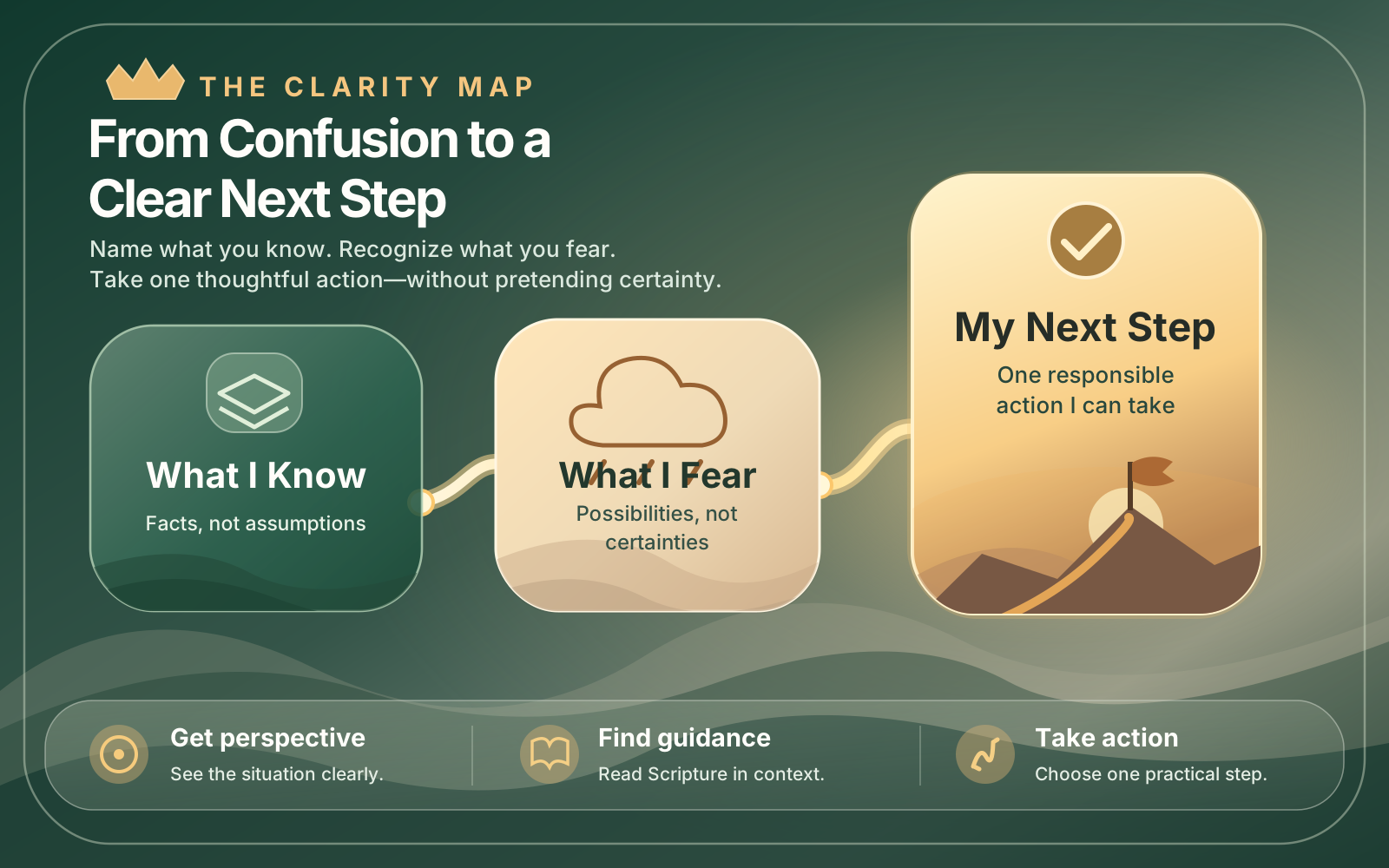
From confusion to a clear next step.
A simple path through what you know, what you fear, and what you can do next.
- 01What I KnowFacts, not assumptionsName what's true today.
- 02What I FearPossibilities, not certaintiesNotice what's still uncertain.
- 03 My Next StepOne responsible action I can takeChoose a practical step, not a perfect forecast.
A ten-minute practice for an unclear day
- Name the situation in one sentence. “I'm deciding whether to accept the offer,” or “I'm not sure what to do after this conversation.” Avoid trying to solve every problem at once.
- Separate facts from forecasts. Write what you know, what you suspect and what you fear. They're not the same category.
- Read one passage with its surrounding context. Choose from the passages above, then read beyond the verse that first caught your attention.
- Ask one better question. Instead of “How do I guarantee the right answer?” try “What would honesty, wisdom and care require here?”
- Identify one next step. It may be gathering information, asking for advice, setting a boundary or allowing time for a serious decision.
This process will not remove every uncertainty. Its value is smaller and more honest: it creates enough space to think, read and respond without pretending to control the future.
A free five-minute reflection
A small exercise you can actually use today
Take a blank page or open a note on your phone. You don't need to write a life story. Work through four prompts:
- The decision in one sentence: “Right now, I am trying to decide…”
- One fact I can verify: What could I check today that would help me make a better-informed decision?
- One fear I'm treating like a fact: Which outcome worries me even though it hasn't happened?
- One person and one action: Who can offer wise counsel, and what responsible step could I take in the next 24 hours?
Worked example: “I'm thinking about leaving my job. I haven't confirmed the salary or hours of the other offer. I'm imagining that changing roles would be disastrous. Today I can request the written terms and discuss the decision with someone I trust.”
This isn't a spiritual scorecard. It's a practical way to bring the search for wisdom together with the responsibility to act on reliable information.
What these verses do—and do not—promise
Questions people also ask
Does feeling confused mean God is not guiding me?
No single biblical passage allows us to conclude that uncertainty proves God's absence or a failure of faith. Wisdom often involves learning, waiting, seeking counsel and acting responsibly in imperfect circumstances.
Which Bible verse should I read first when I'm confused?
James 1:5 is a useful starting point for the question of wisdom. Read James 1:2–8 to understand the setting and then consider Proverbs 15:22 when you need input from others.
What if I pray but still don't know what to do?
Prayer doesn't remove the need to assess facts, seek advice or weigh consequences. Rather than treating continued uncertainty as a verdict, you can take a small, wise step and return to the question as you learn more.
Can a Bible app decide what God wants for me?
No. CROWN is designed to bring you back to Scripture, explain context and support reflection. It does not speak for God, replace your judgment or provide private certainty about a decision.
The verse is a beginning. What comes next matters.
When your situation is more complicated than a search query, CROWN is designed to help you bring the question to Scripture, explore its context and reflect on a next step worth living. The Bible reader is free; recurring guided Carry features are part of paid plans.
Explore how CROWN works CROWN does not speak for God. You don't need the app to use the free Clarity Map above. App Store availability is shown on the main site.